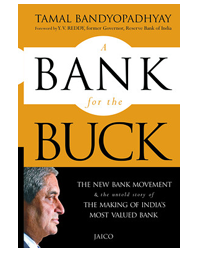
 Business Journalist, Tamal Bandyopadhyay in his book, A Bank for the Buck, takes us on a journey on the making of today's top banking name - HDFC Bank. The transformation from the Housing Development Finance Corporation Ltd to HDFC Bank of today has not been an easy task. The author, through a thorough research and close watch of the Indian financial sector for over fifteen years, has highlighted this in his first book. Business Journalist, Tamal Bandyopadhyay in his book, A Bank for the Buck, takes us on a journey on the making of today's top banking name - HDFC Bank. The transformation from the Housing Development Finance Corporation Ltd to HDFC Bank of today has not been an easy task. The author, through a thorough research and close watch of the Indian financial sector for over fifteen years, has highlighted this in his first book.
Bandyopadhyay has maintained an informal style of narration and the entire story of the making of HDFC Bank does not run chronologically but thematically. The first section of the book illustrates how the bank was conceptualized, the making of the core group of people (whom he humorously tags as the Dirty Dozen) and how the first recruits of the bank not only supervised the building of its first brick and mortar headquarters but were also trained under a tree! Bandyopadhyay delves into the decision making process of each of the leadership team who made a choice to leave their high paying jobs for the opportunity of building a bank in the newly liberalized India. He examines how the first set of banks started operations in the country after the RBI opened doors to private sector players; few of these banks survived the competition while others just fizzled out.
The heart of the book lies in the second section which elucidates the bank's business philosophy. The author makes some interesting comparisons between various banks and HDFC Bank stating that the latter "is staid and waits for opportunities but emerges a winner at the end of the day." Among many other important concepts, the bank was one of the first to leverage technology to start mobile banking coupled with other philosophies such as product innovation and risk management.
Inspite of the various strides that HDFC Bank as a bank achieved, the book examines how it came under the RBI's scanner and was penalized on two occasions - the derivatives and IPO scams. However, these events were not only turning points in the history of HDFC Bank but the bank took steps to avoid getting into such a mess in the future and ensured that 'safety valves' were in place. An entire chapter is also dedicated to the 'Common Sense Banker' - Aditya Puri, the longest serving Chief Executive Officer of any bank in India.
A sneak peek into HDFC Bank's history and its culture, the book makes for a compelling read even for non-banking and non-finance professionals who often shy away from otherwise heavily loaded finance topics. However, note that since Bandyopadhyay's narrative is informal and the fact that the author peppers the narrative with too many characters and trivia, like an early ban on using paper cups as a cost saving measure for all times (which gives us a view of the Indian entrepreneur's mind-set), can make the reader go a little off course.
Aside from the tedious amounts of detail about every one of the "Dirty Dozen", the key lessons from the HDFC Bank story is that the freedom for professional managers, non-interference by the Board and the Promoter and passion for success are more important than ownership. The book illustrates this formula - something new private & existing banks and corporates as such, can imbibe.
To read complete issue click here
|





 The ELS Lotus logo is trademark of Empowered Learning Systems Pvt. Ltd.