|
|
|
|
| |
Dear Reader,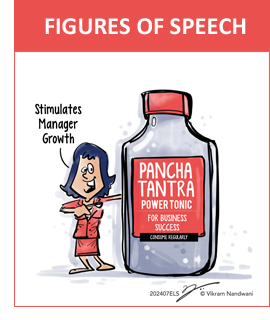
In an era dominated by rapid technological advancements and complex global markets, the timeless wisdom of the Panchatantra offers invaluable lessons for today's managers. This ancient Indian collection of fables, attributed to Vishnu Sharma, is not just a treasure trove of moral stories but also a manual of practical and strategic advice relevant to contemporary management practices.
Incorporating the wisdom of the Panchatantra can help today's managers navigate the complexities of modern business with timeless principles of strategic foresight, collaboration, adaptability, ethical conduct, and humility. By doing so, they can not only achieve organizational success but also foster a more resilient and harmonious workplace.
ET this month looks at 'Wisdom from the Panchatantra for Today's Managers.'
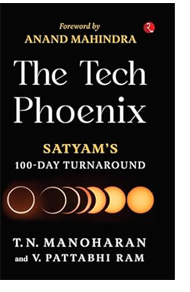
In the Thinking Aloud section, Jay explains that social media spreads distorted information for political gain, prompting a renewed interest in ancient texts and indigenous cultures as societies reclaim their history and identity. On the Podium, Managemet Consultant Vijay Laghate explores how the Panchatantra, a 2,000-year-old collection of stories by Vishnu Sharma, remains relevant in the business world by teaching timeless lessons on leadership and human nature through simple, engaging tales. In the We Recommend section, Jay reviews "The Tech Phoenix - Satyam's 100-day Turnaround" by T.N. Manoharan and V. Pattabhi Ram which accounts for the swift and collaborative efforts of industry leaders and government officials to rescue Satyam Computers from a massive fraud scandal, ultimately restoring its stability and preserving India's software industry reputation.
In Figures of Speech, Vikram's toon unveils the secret sauce to business success!
Please also Click Here to check out our Special issue of ET, which is a collation of selected themes that were featured over the years highlighting the changing landscape of the business world. This special edition has been well received and can be Downloaded Here for easy reading and is a collector's item.
As always, we value your opinion, so do let us know how you liked this issue. To read our previous issues, do visit the Resources section on the website or simply Click Here. You can also follow us on Facebook, LinkedIn, X, Threads & Instagram - where you can join our community to continue the dialogue with us!
|
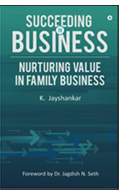
Out Now!
Succeeding in Business: Nurturing Value in Family Business
Click below to order your copy now


|
|
Special offer for Empowering Times readers. Get 30% discount by using coupon ETSPECIAL on the Notion Press online store.
Click here to connect with Jay.
|
|
|

|
|
Arguably the most prolific global university in recent times is the WhatsApp University. The advent of social media has suddenly created a vast number of graduates of this university who spend hours reading tomes and watching videos extolling virtues of a person created by vested interests. This phenomenon is universal as technology (and cheap bandwidth) has made access to information easier than ever before in human history. Political parties have latched on to the power of this medium and sharpened their skills to manipulate and misuse the technology and in every part of the world, elections are the best period to go viral with distorted data and concocted stories to serve hidden agendas. Foreign powers have been known to meddle in national elections to suit their agenda as inflaming populace is an inexpensive but highly effective tool of war. Thus forgotten shards of history are dug out of the past, embellished with messaging to suit today's agenda and then offered for consumption to the gullible who are seeking a fantasy world where everything was perfect. This is an easy escape route to avoid accountability for today's (in)actions and a convenient way to romanticize the past of which multiple versions exist and never be fully verified.
What of ancient texts then which present heroes, both well known and unknown, who seem to have overcome challenges galore and from whose journey we draw meaning for our current existence? The colonization of nations has always succeeded when the imperial forces colonized minds. Perpetuating the control of land masses needed the destruction of the local, indigenous culture and the victim nations with broken spirits had to become willing supplicants to the aggression of the victor who would willy-nilly claim superiority in all matters. Thus language, religion, food, clothing, and every other aspect of life had to be supplanted with the methods and manners of the ruling group. Consequently, doubts were also cast on the texts of the ruled as the inferiority of the subjugated had to be reinforced at every step.
However, the winds of change that freed many nations in the mid-twentieth century have finally begun to shake the prevalent establishment that were imposed by the western colonial conquerors. All over the world we see a renaissance with indigenous voices getting louder as they wish to reclaim their culture, traditions, and history. Be it Australia, New Zealand, Canada or nations in Africa, their vociferous declarations are getting the attention that they deserve. New Zealand, in particular, has seen loud expressions of Māori traditional practices, culminating in the Haka by their 21 years young member of parliament, Hana-Rawhiti-Maipi-Clarke, in December last year, an impactful action that brought global attention.
This move of restoring cultural awareness has often been seen as a political statement which is unfortunate. There is no doubt that politicians pander to the lowest common denominator when it comes to winning office but that by itself does not mean that accepting one's traditional context is anti-modern, backward or primitive behaviour. Every ancient civilization (be it Chinese, Egyptian, Persian, Indian, etc.) achieved greatness because it built its own ethos suitable to its own environment. The cycle of civilization has shades of natural process, as outlined by the historian, Arnold Toynbee. Indeed there is genesis, growth, breakdown and disintegration of every society but unlike the physical structures that are washed away with time, cultural ideas and even great texts survive when they are passed on to the coming generations, either in writing or through oral traditions.
In the Indian context, there is finally a national self-assurance leading to the acceptance of its ancient knowledge, be it in philosophy, statecraft, economics, arts, and sciences. Viewed as a treasure trove, treatises like the Vedas, Ramayana, Mahabharata, Bhagavat Gita, Upanishads, Arthashastra, Tirukkural, Panchatantra, Sushruta Samhita, Milinda Panha, Shatkhandagama, Jatakas, etc., are now being referred for lessons in multiple fields. These books in Sanskrit, Pali, Prakrit, Tamil, and other languages are also being reinterpreted to modern times by the popular teachers who have found new audiences, both corporate and others. Extremely communicative in multiple languages, many of these new-age teachers have also harnessed the power of technology to address followers across the globe. The messaging may well be part-truth, part reinterpreted reality, but there is now new hunger to learn from the old world, as a new India understands that we were not the boors or savages as portrayed by the western world who lorded over us.
This is also a reminder to those of us who have forgotten our roots that philosophers, artists, scientists and story tellers existed well before the Greek, Latin, English or French set out to establish their mark on the world. And, if we choose to refuse to learn from ancient knowledge we could well suffer the fate that George Santayana wrote about that 'those who cannot remember the past are condemned to repeat it.'
back to top ^
|
|

|
|
 After retiring from the chemical industry, Vijay S. Laghate has been passionately exploring the rich heritage of Bharat since 2017. Vijay's academic journey began with his studies in Chemistry at IIT Kharagpur and IIT Kanpur, where he was a National Science Talent Scholar. He furthered his education with an MBA from IIM Ahmedabad and attended the Senior Executive Course at Manchester Business School under a scholarship from the British Council.
Vijay's professional career in the chemical industry spanned various sectors including synthetic resins, synthetic fibres, pharmaceuticals, fertilisers, and natural gas. He played a pivotal role in introducing modern technologies and new products to the chemical industry and served as the industry lead for a significant research project at CSIR-National Chemical Laboratory in Pune.
As part of the Government of India's Expert Group on Petrochemicals, Vijay authored a key report on the Synthetic Fibre Industry, which catalysed substantial investments. He has made significant contributions to government policies on the pricing of petroleum products and natural gas. His leadership extended to serving on the Executive Committee of the Indian Chemical Council's Western region.
Vijay's insights have been shared through articles in prominent publications such as the Economic Times, Business World, and Indian Management. He has also delivered lectures on industry and management topics both in India and overseas. His leadership roles include serving as the President of the Association of British Scholars, Pune chapter, and the Alumni Association of IIM Ahmedabad, Pune chapter.
In English, some notable translations and must read include those by Arthur W Ryder in 1925 and G.L. Chandiramani in 1991. The Hindi translations were done by Jwala Prasad Mishra in 1910. For Marathi readers, H.A. Bhave's translation, published by Varada Prakashan Pune, is available in its 4th edition as of 2022.
ET: What is the Panchatantra and what makes the Panchatantra timeless and universally applicable in the business world?
VL: The opening lines of the Panchatantra text describe it as a text book of Neeti Shastra, prepared by extracting the essential teachings from its preceding texts. It is a treatise where a wise guru teaches statecraft to three young princes who will, in due course, have to manage their father's vast kingdom. Its 71 stories contain 1,100 beautiful sayings (or"Subhashitas" in Sanskrit) about human nature, how to deal with difficult situations and get ahead in life.
Its author is Vishnu Sharma, who lived about 2,000 years ago. Its stories have enthralled millions of readers over the ages. It is India's most widely translated book with about 200 editions in about 50 languages globally. Its first translation outside India is recorded in the Pahalvi language of Persia in about 550 CE. It has spread all over the world entirely on its own merits.
The special merit of the Panchatantra is that it explains concepts of statecraft in simple language, and through the medium of short stories that both entertain and educate.
Since Panchatantra is about statecraft, it usually talks about kings, ministers, kingdoms, etc. We can apply the principles of Panchatantra to the business world by interpreting the king as being the chief of an organisation, ministers as being senior managers, and kingdom as being the business organisation. The king's enemies can be interpreted as business competitors; and killing of enemies as simply success in business.
Many of the concepts mentioned in the Panchatantra continue to be valid even today, indicating that essential aspects of human nature have not changed much over the millennia.
ET: Please share 5 lessons from the Panchatantra which are most relevant for today's business leaders?
VL: The Panchatantra offers many lessons that have relevance for today's business leaders. Given below are a few.
- Inculcate boundless enthusiasm/ perseverance -
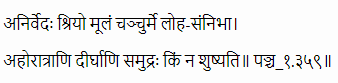
Translation: "Self-reliance, indefatigable work with enthusiasm is the source of wealth/ fame/ success.
A small bird says that he will work day and night to empty the ocean with his strong little beak!!"
This verse is from a story where a small bird feels he has been wronged by the ocean, and he vows to take revenge by emptying it of all its water! In the story, he does defeat the mighty ocean - after persuading superior powers to help him.
Business Application: This story reminds me of Dhirubhai Ambani – when he started his journey, was he like this little bird? A nobody, completely self-reliant on his own wits – he had the audacity to dream so big that he created the giant that is today Reliance Industries.
- Develop your people -

Translation: Just as a gardener waters his plants regularly in the expectation of getting good flowers/ fruits, a King who wants good results should carefully nurture his subjects with respect and material support.
Business application: The employees are crucial to the success of the growth plans of the business leader. Treat them well, and help them grow.
-
Encourage Creativity - intelligence is the key
The Panchatantra places great value on Intelligent Thinking.
It declares boldly that
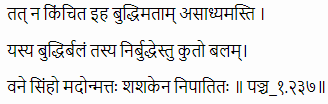
Translation: Nothing is impossible for the intelligent!
He who has intelligence has capability; the un-intelligent don't.
That is how a (puny) rabbit got rid of an arrogant lion!
All the Panchatantra stories have very creative themes. They typically show how the weak overcome the strong. In this well-known story, the rabbit plays on the ego of the lion to make him fight his own reflection in the well! Doesn't this show that the author of the Panchatantra is a highly creative person? In fact, the Panchatantra is so well liked because this high level of creativity permeates all the stories.
In short, Panchatantra teaches us to think, not just out of the box, but rather to
Think Far Out of the Box.
Business application: Business leaders may consider how they can encourage creativity among their staff, and in all their operations. In today's fast changing world that is getting enhanced with AI it's crucial that Human Intelligence and Creativity is developed more and more.
Have good advisers

Translation:
A line of policy devised by
talented men of good behaviour,
who are our well-wishers,
are well versed in their subject, and
are renowned for their intellect,
will not fail to achieve the objective.
Business application: Have good advisers, with the qualities mentioned above, to help you with your business plans.
-
Be realistic about growth

Translation: One who proceeds to war after evaluating his own strengths/ will-power properly, his level of determination  to see the battle through to the very end, and understands that his self-respect and reputation to see the battle through to the very end, and understands that his self-respect and reputation  is at stake – he can kill many enemies. is at stake – he can kill many enemies.
Business application: Keeping in mind the interpretations of various words mentioned above, this verse describes the mental and psychological factors that the leader should evaluate before venturing on a business plan to capture a new market or increase market share.
Indomitable Courage in the face of Adversity
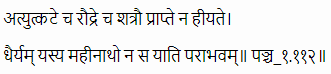
Translation: That Raja never gets defeated whose courage does not diminish even when confronted by very fierce and aggressive enemy.
Business application: Every business faces difficulties. The Business Leader must maintain his courage and lead the organisation out of the problems.
Build your Core Strengths
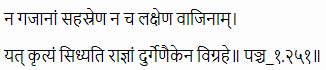
Translation: A good fort can protect a Raja/ kingdom from enemies better than soldiers on a thousand elephants or a lakh of horses.
Business Application: Your kingdom is your business. The Fort is the core strengths / competencies that will sustain your business through bad times. Identify what these are for your business. Build them up to make sure you have an impregnable core. The corollary is to understand the vulnerabilities, and patch them up.
ET: How do you integrate ancient wisdom from texts like the Panchatantra into modern management practices?
VL: At present, the Panchatantra is viewed as just an entertaining book of animal stories meant for children. Usually, only the story part is placed in front of readers.
What needs to be done is to provide the full text, along with the sayings and the stories. Then the wisdom of the Panchatantra will become available to readers today. In addition, it is worth having groups to come together to discuss various aspects, so that the concepts become clearer and better absorbed.
A word of caution - while many things of yesterday are applicable today, there are some that are not. The reader must use his discretion in deciding on what to take and what to leave out.
ET: What are other similar texts from ancient Indian writing that you believe has relevance to the modern world of statecraft and business?
VL: The Panchatantra itself acknowledges its debt to Kautilya's Arthashastra, the famous text on political science and the economy.
Another useful text is the Chanakya Neeti, which is more concerned with day to day life. Though Kautilya and Chanakya are believed to be the same person, the Arthashatra text is always associated with Kautilya, and the Neeti text with Chanakya.
The Shanti Parva in the Mahabharata includes sections that discuss various aspects of administering a kingdom. One such section is the Raja-dharma-anushaasana Parva, wherein Bhishma imparts his knowledge on the subject of Raja-dharma to Yudhisthira. The word Dharma in Sanskrit means that which sustains and is a firm foundation. So, Raja-dharma is all about the proper conduct of a king, by which his kingdom will develop a strong foundation, and will sustain for long.
ET: Can you share a brief overview of your career and how you became a management consultant?
VL: I am a retired business executive. I studied management at IIM Ahmedabad, after having studied chemistry at IIT Kanpur and IIT Kharagpur, as a National Science Talent Scholar. I made a career in the chemical industry, spanning synthetic resins and yarns, pharmaceuticals, fertilisers and basic chemicals. I have written many articles and given talks, in India and overseas, on industry related topics. I also participated in several industry- government policy deliberations.
After retirement, I continued with my last employer as a consultant for a few years.
I now spend my time learning about the rich literary and scientific heritage of Bharat.
back to top ^
|
|

|
|
"Once you start down the dark path, forever will it dominate your destiny. Consume you, it will."
(Yoda)
Businessmen in India are viewed with suspicion till today. Given our chequered history of social injustice, and the association of cronyism that businessmen have had with the powers-that-be since the British reign, the wealthy have always attracted misgiving and mistrust from the larger numbers of the economically deprived. The leftist era of socialism rendered such a hard blow to the psyche that even the post-90s liberalization has not been able to create confidence in political parties to admit that yes, capitalism is not evil. Perhaps, it will take another generation of young entrepreneurs with their start-ups to change the perception that businessmen (and increasingly, businesswomen) are indeed a source of good for society.
However, in such a vitiated business environment every road bump in the tumultuous economic world can cause severe consternation and panic. Over a decade-and-half ago, there was one such event that caused dangerous tremors and cracks in the edifice of the unblemished software industry's carefully built structure. This was the 'Satyam scam' as the popular press called it. The event rocked Indian industry as never before, with wild calls of vilification that tarnished industrialists of all kinds. However, this can also be cited as a glorious business case where government and industry came together to find a creative solution to a potentially destructive crisis that would have marred the fair name of India's burgeoning software sector.
The book at hand is the inside story of how the storm was handled and calm generated, all within 100 days, by intrepid professionals who were tasked by the government when disaster fell upon a company that was a posterchild of India's new and emergent brand as a software powerhouse. A former President of the Institute of Chartered Accountants of India, T N Manoharan (the co-author) was one of those hand-picked by the government to salvage the tottering firm after the Founder, Ramalinga Raju, confessed to the world on January 7th, 2009, that he had been padding the books to the tune of over Rupees Five Thousand Crores in connivance with a select group of co-conspirators. The government acted swiftly and appointed a new Board to take over the firm and find not just answers to the puzzle of corporate misgovernance but also find a way out of the mess as the scam destroyed the credibility of many institutions, and devastated lives of employees. Under the steady hands of industry stalwarts like Deepak Parekh and Kiran Karnik, the eminent authorities of the new Board worked closely with the government, industry bodies (like NASSCOM), and many other others, to win back customers who had walked away and restore the pride that employees had in their old firm.
Privy to the inner workings, the author offers a ringside view of how the tide was turned, and the phoenix revived and now thrives as Mahindra Satyam, an important part of the Mahindra empire. It is a tale stitched together with anecdotes, events, and reflections from this never before (and hopefully never again) blot in India's industrial journey. The world has seen bankrupt firms and capricious leaders before (and since 2009 also, to be fair) but the systemic shock that Satyam caused had reverberations in all sectors of a young economy still coming to grips with a new model of meritorious capitalism, after decades of government regulated industrial development. The unique manner in which a creative solution was generated is all credit to the various stakeholders who rallied to the crisis and saved not just the firm but also India's reputation.
The book does not delve too much into the deeper reasons why the Founder had strayed from the path of creating a globally respected firm into the world of fraud and deceit. Speculations abound (greed, malintent, etc.) but that is left to other writers. Instead, Manoharan does not fail to highlight the good work that Raju had done, characterizing him as Janus faced. The good side (Dr. Jekyll) was the Samaritan who harnessed the power of tech savvy Satyam to build the unique Emergency Management and Research Institute (EMRI) – popularly known as the 108 Service – that has now revolutionized emergency medical support in various states, and many more projects under the Byrraju Foundation's social initiatives. Nevertheless, the dark side, Mr. Hyde, was the one who destroyed everything wonderful that had been created; an iconic firm which was the pride of Andhra Pradesh became a byword of corporate malfeasance, misfeasance and nonfeasance.
Shorn of dramatic turns, this book would be useful to those interested in factual narration of corporate turnarounds. Besides, it is also a reminder to those in charge of corporate destiny that their actions have implications wider than the needs of promoters. Hence, Board stewards too should refresh themselves with this vital piece of business history, while heeding Yoda's words of wisdom.
back to top ^
|
|
| |
|
THROUGH THE LENS
|

|
|
Our in-house nature photographer, Rupesh Balsara spots the Golden Flameback, also known as the Common Flameback. It is a striking woodpecker found in the forests and woodlands of India. Preferring dense, moist forests and plantations, this bird is primarily insectivorous, feeding on ants, beetles, and other insects by pecking into tree bark. The vibrant plumage and characteristic drumming of the Golden Flameback make it a remarkable presence in its natural habitat.
|
|
|
|
Empowered Learning Systems
www.empoweredindia.com
101, Lords Manor, 49, Sahaney Sujan Park,
Lullanagar, Pune – 411040,
Maharashtra, India


|
 The ELS Lotus logo is trademark of Empowered Learning Systems The ELS Lotus logo is trademark of Empowered Learning Systems
©2024 Copyright Empowered Learning Systems (ELS). For private
circulation to clients and well-wishers of ELS. While ELS endeavors to ensure
accuracy of information, we do not accept any responsibility for any loss or
damage to any person resulting from it.
|
|
|
|
|
|
| |