|
|
|
|
| |
Dear Reader,
The education sector was not immune to the ripples of the global crisis. Along with businesses being in lock down mode, the pandemic led to the closure of educational institutions and students, parents and educators felt the extraordinary impact of this.
With every challenge comes an opportunity to adapt and transform. The current situation presents an opportunity to reinvent the education sector that will come with its own set of challenges. The pandemic has a lesson to teach us, so to say. It has highlighted the importance of moving learning experiences beyond the traditional school building and hours and has identified the gaps in how educational services have been imparted.
ET this month looks at the 'The Academic Challenges of the Pandemic Era'. On the Podium, Dr Pankaj Chandra - Vice Chancellor of Ahmedabad University shares some of the new challenges faced by India's higher education institutions in these trying times. Technology continues to re-define the way we will teach children/students and will transform the education sector like never before.
In the Thinking Aloud segment, Jay shares his thoughts on the unexpected changes due to the pandemic and the opportunity to re-wire the entire education process. In the We Recommend section, Sudhir Sitapati's book, The CEO Factory, recounts his journey in Hindustan Unilever, a household name, and how the company has successfully instilled skills and values and churned out many CEOs and CXOs who now manage other Indian business.
In Figures of Speech, Vikram's toon teaches us a lesson to re-invent!
A gentle reminder. August 13th is the Indian Organ Donation Day. Become an active participant - and save lives!
As always, we value your opinion, so do let us know how you liked this issue. To read our previous issues, do visit the Resources section on the website or simply Click Here. You can also follow us on Facebook, Twitter & LinkedIn - where you can join our community to continue the dialogue with us!
|
|

|
|
The belief that Covid-19 is a sickness that has afflicted the older generation hides a deep problem. Perhaps, the group that has been most impacted are the young, school & college going students whose live has gone into a tailspin as they are suddenly confronted with a deep disruption in the middle of their carefree existence. Central to their life is education - which meant attending classes at school - and let's be honest - some wonderful time with friends, away from the eagle eye of parents. But, the virus has changed their world without warning.
Of course, the impact of disruption in education is not just for students & parents alone. The academic world - teachers, staff, government, etc. - are all clutching at straws now not knowing what hit them, and more to the point, not knowing what to do next. As I write this, confusion has been further confounded with changes in policies, nationally & internationally. After many agonising days, high school students have been told that there will be no further school leaving exams, and those with entry level admissions to college are awaiting clarity on whether there will be physical or online classes. Coupled with this is the debate on fees. Why should Tuition fees be the same if the classes are online, argue parents who are already cash strapped & under financial pressure from wage or job cuts.
Fair questions all and none have ready answers. Truth be told, we are in limbo and seeking a way out desperately.
Some things, however, are becoming clearer. One, this is a great opportunity to take a look at the entire education process, be it at school, college or for that matter, corporate education too. For too long has learning been a hostage to education. Schools and colleges are factories offering education as a product and learning as a by-product. As with all traditional institutions, the education system has long been frozen in a world which has resisted change. In India, perhaps more than in other parts of the world, education has been a victim of government policy with multiple debates ranging from issues of centralization of courses, need for vocational & aptitude led programs, the role of sports, issues of language of study (local, mother tongue, national, English, etc.), funding, quality of teaching staff, and a myriad of other matters. Government committees galore have suggested changes but to little avail. Sometimes it boggles one's mind that despite these challenges India produces bright minds who seem to be in great demand for leadership roles overseas!
Perhaps, the most vexatious issue is the external challenge that has been posed by the advent of technology into the academic world. Not unsurprisingly, the vast majority of teachers/professors were the last to understand that teaching methods needed modification in a world where professor Google had joined all teaching institutions. This unexpected competitor lured inquisitive students away from the drudgery of the classroom but even today many teachers do not know how to leverage technology as an enabler for sparking bright minds. If only they realised that downloading information is best done through the machine and that their job is to arouse curiosity and challenge students to stimulating debates that nurture new ideas.
It is not my case that all learning can be left to the massive open online courses (MOOCs) model but there is no reason to be a prisoner of the past and not innovate. Inherent to innovation is failure and this is perhaps the unacceptable part as no one (least of all a centre of learning, aka university) would like to be seen as gambling with a young person's future. Also, admittedly, the challenge of evaluation and having standard assessments is a problem that has not been cracked to the satisfaction of a larger majority. But one may argue that this has not held us back from accepting the reality that across the world different standards do exist.
Therefore, while there is no easy answer to this conundrum, some points can be accepted uniformly. Let me highlight three, to begin with, as we reimagine a new world of education, compelled as we are by the unexpected changes due to the pandemic:
- Leverage technology: it is the cheapest way to reach large numbers of learners everywhere, provided we can ensure access to devices (tablets, computers, smartphones, TVs, etc.). Learning not only becomes more 'alive' to young minds, it breaks the barriers of fixed schedules too, amongst other benefits.
- Invest in faculty development: enable teachers to become adept at the new medium of transmission. If they fail to comprehend their new role in a changed environment, students will continue to suffer. Quality faculty is the source code for true ignition of knowledge.
- Make learning holistic: no longer should students learn only about Science or Arts, the need to make learning inter-disciplinary is essential. Let them co-mingle and understand the relevance of sustainable learning for life.
Clearly, the above is not a panacea but mere pointers. There is a new wind of urgency that is blowing across the world and the pandemic has brought to focus many important issues that have been ignored for a long time. Policy makers have forgotten Mandela's words that 'Education is the most powerful weapon which you can use to change the world' and the sector has remained under-invested. Perhaps, the virus could be a blessing in disguise as it has made us all to take serious note of a neglected subject & hopefully will galvanise change.
back to top ^
|
|

|
|
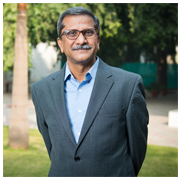 Professor Pankaj Chandra is the Vice Chancellor of Ahmedabad University. He was the Director of the Indian Institute of Management Bangalore (2007-2013) and Professor of Operations & Technology Management at IIM Ahmedabad and IIM Bangalore. He holds a BTech from the Banaras Hindu University and a PhD from The Wharton School, University of Pennsylvania. He has been a full time faculty at McGill University and IIM Ahmedabad and a visiting professor at the University of Geneva, The Wharton School, International University of Japan, Cornell University, and Renmin University, Beijing. He was the first Associate Dean (Academic) at ISB, Hyderabad.
Professor Chandra was a member of the Government of India Committee on Rejuvenation of Higher Education (Yashpal Committee) that relooked at the Indian Higher Education system as well as the Committee on the Autonomy of Central Institutions. He has been a member of the Telecom Regulatory Authority of India (TRAI).
Professor Chandra's research and teaching interests include Manufacturing Management, Supply Chain Coordination, Building Technological Capabilities, higher education policy, and hi-tech entrepreneurship. His recent book titled 'Building Universities that Matter' studies issues of Governance, Change & Institution Building in Indian Universities. He serves on boards of several firms and institutions.
ET: The Covid-19 pandemic has suddenly turned the world upside down. Not just students but the entire academic world is facing tough times. What are some of the new challenges faced by India's higher education institutions now?
PC: The pandemic has thrown the university out of its regular mode of thinking and doing. Seven key challenges have wrapped the universities up in knots.
First, universities have had to adjust to sudden closure. Students had to rush back home, uncertain when they will finish their courses, when will they write their examinations, and when will they graduate. Uncertainty has increased for all and especially for those graduating as jobs have shrunk or their joining has been delayed. Two, universities are social organizations and students learn by engaging with each other socially as well as in the classroom - they learn through engagement and through others outside and inside the class. That world has been disrupted and universities and students have to find alternative ways to complete learning. Three, most university organizations are large bureaucracies and they were caught unprepared with their administrative systems unable to transit easily to online and work from home. The more efficient ones transited easily. Four, universities and students, have come to grasp the fact that much of their teaching and learning will have to be online for this year, if not longer. Most institutions have done that experiment and discovered its advantages and its inherent weaknesses. The technology is still in its infancy, as large number of students in the country do not have a computer; mobiles are a bad way of studying for a course; and internet access and bandwidths are poor across the country. All of these are affecting learning as is screen fatigue. Five, the faculty across the country have to learn to teach differently for the online medium and it is not something that is natural to them. Six, as the new world order in the society, economy and the world are changing. It is difficult to predict what happens. This means that many theories and premises of the past have to be re-thought, re-imagined, and researched afresh. Teaching and research questions have to be seen in a new context and under new rules of engagement. Old textbooks and theories will not hold good. And finally, the cost models of many universities will go out of kilter as they are dependent on government support and if the economy does not pick up then Indian universities will be in further trouble as there would be cuts in resources from a base that is already very low.
ET: The education sector has constantly faced a barrage of criticism for outdated models of teaching. In your opinion, has the pandemic created new opportunities that can be tapped by educational institutes? How will teaching & learning change post Covid?
PC: The issues are not outdated models of teaching. The issue is standardization in content and low autonomy of institutions to design and craft their own curriculum and teaching methods. Also, to establish their own processes to hire those who can best teach or develop the best learning environment. Experiments have not been part of the higher education landscape as they are practically extinguished by the governments that regulate education.
I don't think much will change in the quality of teaching and the ability to inspire in the current scenario. Online is just a medium to learn but in education the message is the medium. Unless the message changes - what one teaches, how one teaches, how one inspires one to learn, how one applies what one is learning, etc. the world of learning will not change. Teaching and learning are social acts which are best done through the context in which the society and the learners are placed. Unless that aspect is understood, nothing much is going to change in the country or anywhere in the world.
One thing which, however, is going to change post-pandemic is that many theories and premises of the past, will be no longer remain valid whether they are in humanities, social sciences, or even the professions. Organizational foundations are being questioned severely whether they are business organizations or social groups or governments. Inter-relationships between organizations and countries are being re-drawn. Trust, which is the bedrock of any transaction and development has become short in supply. New skills that are at the boundaries of disciplines are going to be required for the new types of jobs that might develop post this crisis. The big question before academics and universities is how to build a new curriculum and pedagogy in light of these kinds of changes. This will define whether educational institutions and their thinking will remain salient or not.
ET: Digitization & enhancing the use of technology is seen as the solution to many ailments in education. But has this just increased the divide in society between the digital haves & have-nots?
PC: Use of technology is not the solution to the ills of higher education. The problem lies in the structure of governance of higher education and its execution.
Having said that, yes, it has become challenging for many students to operate in these times. Most do not have computers. They use mobiles which are bad devices through which to spend four to six hour of classes or for doing assignments. Many do not have internet connections or are shared with several at home - the bandwidth is so low that their connection keeps dropping in the middle of the class and even going to an LMS is a highly disrupted affair. Then, what about labs and workshops? Universities and colleges do not have the same distribution of technology as well as people to support it. So yes, this has accentuated the digital divide. Interestingly, neither have the computer sellers nor the telecom companies come up with reasonably priced student packs or loans for purchase of devices. It is a market that has suddenly become very large and one wonders the intent and strategy of these companies.
ET: The cost of quality education (both primary & higher levels) has seen rapid escalation over the last decade. As a socially minded educationist what are your thoughts on access to quality education in India, particularly in the light of a growing number of private universities?
PC: Quality education is expensive. The costs will continue to rise as a large number of resources for higher education are available at very high costs in India - lab equipment, chemicals & reagents, quality books and journal, software used by educational institutions, computers, servers, and storage, etc. Quality faculty also have great opportunity cost and wage bills have been increasing. The problem is made worse by the fact that citizens have to bear most of the cost because the government spends very meagrely on education. It should be spending 6-9% of GDP on education. The government spend is about 3%. Government spend on public institutions (except on a few national institutions) is very low resulting in poor learning infrastructure. To top it, the number of seats in half decent public institutions is so few that most students are shut out from even average education. So where should they go? Private institutions fill in this gap in demand and supply of quality education. Poor quality institutions whether private or public should be closed down anyways as poor quality education is no education at all.
I would like governments to increase their spending on education and especially on those who cannot afford the cost of education. Fees should reflect the cost being incurred at the institution and the ability to pay. Where is the logic of charging same fees from a kid who can afford it and another who cannot afford? Besides, the student who needs it should be given funds irrespective of where she chooses to study - private or public.
Access to quality education is also a function of good facilities, good faculty, and freedom to experiment with teaching and learning at the level of the school or the university. Indian universities are too small in enrolment size. Given the paucity of resources it makes sense to consolidate and make the better ones large so that they can deliver high quality education to a larger number as they have generally figured out how to do so.
ET: You are a well-respected academician with a broad spectrum of experience in management, business, and government (having been part of several high-powered committees). As the Vice Chancellor of Ahmedabad University what is your vision for the university and the mandate that you are executing?
PC: Ahmedabad University is a young liberal arts driven research university. Its mandate is to become a leading research university that develops new knowledge for the world and an institution that will get to be known for its ideas and by how its students impact the society. We are building the next generation university where learning is around solving complex problems, where learning is necessarily interdisciplinary to be able to address these complex challenges, where learning is by doing (in addition to learning by thinking, learning by connecting, and learning by becoming) and where research thinking is about learning to ask the right questions. We are building a new way of teaching and learning that is built around engagement, deep conceptual understanding, and sharp & dogged application. The University is already attracting some of the best faculty from around the world. Their research is around real issues facing the society. The diversity of Ahmedabad University is high, and we have students coming from 22 states of the country last year. Our strong mandate is to also bring students from underrepresented communities as well as those wo are first time learners in their families. We have need blind admissions and we feel that we are equalizing opportunities for our children from different socio-economic backgrounds. Our philosophy is not to become an institution for the elite but bring kids from all kinds of backgrounds who will go out of the university as elites by virtue of their education and by what they do. Our vision is to become an institution that matters!
Ahmedabad University is a multi-disciplinary institution comprising the Amrut Mody School of Management, School of Arts and Sciences with its divisions of Humanities & Languages, Social Sciences, Mathematical & Physical Sciences, Biological & Life Sciences, and Performing and Visual Arts, and a School of Engineering and Applied Sciences. We also have four very interesting centers - Global Centre for Environment & Energy that focuses on Climate Change & Sustainability; Centre for Heritage Management that works on conservations and management of tangible and intangible heritage of India; Centre for Learning Futures that acts as our Reading and Writing Centre and works to develop pedagogies and methods towards the future of learning; and VentureStudio, our incubator that supports start-ups.
Our Centre of City location with almost two hundred acres of land in Ahmedabad's education district provides a culturally rich and safe experience to students who range from undergraduate to PhD. The state of art campus matches the academic aspirations of the University to support the purpose of the university - continuous progress of self and society.
back to top ^
|
|

|
|

Lifebuoy, Ponds, Lakme, Surf Excel, Vim, and Brooke Bond. These are just some of the brands that every Indian household can reckon with. Sudhir Sitapati's first book looks at a name most of us can connect with - Hindustan Unilever Limited (HUL).
Hindustan Unilever, a child of two parents - the British Lever Brothers and the Dutch Margarine Union – merged to create Unilever in 1930. However, 'Hindustan' Unilever has the unique mix of the European Unilever with a special Indian twist to its DNA. The CEO factory is dedicated to HUL and the way it moulded the author to what he is today. Sudhir Sitapati joined Hindustan Unilever in 1999 and is currently the Executive Director of the Foods and Refreshments segment.
As the name suggests, HUL was instrumental in churning some extraordinary management leaders who now look after other Indian businesses. Almost every major company in India has a HUL leader - Gopal Vittal (CEO of Bharti Airtel), Ignatius Navil Noronha (CEO and MD of DMart), Sanjay Gupta (Country Manager of Google India), Suresh Narayanan (Nestle India CMD), and many others.
Peppered with short insights and interviews with past senior executives, the read fulfils its aim of laying out the process of forging the leaders of tomorrow. Being strongly Indian and simultaneously strongly Western is at the heart of the HUL way of management. The narrative also highlights HUL's 'middle class' success mantra of being hard-working, frugal, aspiring, and humble and is laced with Sitapati's own learnings over 20 years.
Some of the broad ingredients that define the company and emulate in the professional lives of these CEOs include: a middle-class soul; a meritocratic culture; walking with kings and yet have the common touch (managers at home in the remotest villages while also speaking to investment bankers in South Mumbai); entrepreneurial professionals (who will walk the extra mile to deliver results) and an unbending integrity where the company would rather shut operations than compromise on values.
Other facets which define CEOs churned out from the HUL factory include the entrepreneurial drive for profits as seen in the launching of Lux Supreme soaps when faced with price controls; the middle class value as seen in a sales manager having a meal at a salesperson's house when he visited the town; the caring attitude showed by a veteran towards a younger manager and integrity as evinced by the refusal to pay what could easily have been called a small lawyer's 'fee'.
What is surprising is that when corporates have to adapt to the changing business world, what has not changed in the HUL way of doing business is the importance of the insight driven big idea, mass media driven by low cost reach and the continued drive in reaching more stores. In recent times, however, one of the big changes seen is the digital transformation of the company.
Although the cover of the book resembles that of a detergent pack from the 1980s (in a way a HUL way to connect with its readers), its contents cover topics such as training, sales & marketing, advertising, costing, and human resources, among other management themes. The book is simple to read and serves as an MBA course to those who want to enhance their leadership skills.
back to top ^
|
|
| |
|
THROUGH THE LENS
|

|
The Indian sub-continent is home to four species of weaver birds or bayas. Our in-house nature photographer, Rupesh Balsara captures a picture of the Indian Baya Weaver. Known for their excellent nest-weaving skills, they feed on grains, seeds and insects and has a high-pitched voice. In recent times, the once common, sparrow-sized birds are slowly declining in number due to the increasing loss of grasslands.
|
|
|
|
Empowered Learning Systems
www.empoweredindia.com
101, Lords Manor, 49, Sahaney Sujan Park,
Lullanagar, Pune – 411040,
Maharashtra, India


|
 The ELS Lotus logo is trademark of Empowered Learning Systems The ELS Lotus logo is trademark of Empowered Learning Systems
©2020 Copyright Empowered Learning Systems (ELS). For private
circulation to clients and well-wishers of ELS. While ELS endeavors to ensure
accuracy of information, we do not accept any responsibility for any loss or
damage to any person resulting from it.
|
|
|
|
| |