|
|
|
THINKING ALOUD
Adding Luster To The Business of Stones
Jay
|
 |
PODIUM
Prasad Kapre
CEO & Director
Style Quotient Jewellery Pvt Limited
|
 |
|
WE RECOMMEND
Click! The Amazing Story of India's E-commerce Boom and Where it's Headed
Jagmohan & Komal Bhanver
|
 |
WONDER WOMEN
Ashwini Deodhar
Co-Founder - Zestorm Technologies Pvt Ltd, Pune
|
 |
|
Dear Reader,
This month in Empowering Times, we look at the Gems & Jewellery Business in India: Current Scenario. This is a theme which will bring a sparkle to your eyes! From the Egyptians who placed great importance to their jewellery to Indians who have showcased their love for these ornaments at festivals and celebrations, the fascination with jewellery continues.
A Mckinsey study backs the growing demand for jewellery. This industry is poised for a glittering future; annual global sales is expected to grow at a healthy clip of 5 to 6% each year to 2020. Although the sector in India faces various challenges, this export oriented and labour intensive industry continues to earn trade revenues and is a sizeable employer. In a country where a lot of value is attached to every piece of jewellery, changing fads and more disposable income is driving demand. Coupled with this, these jewellery pieces have been serenaded by movie stars - one would be amazed by the sheer fan-following these fashionistas derive!
From a retail perspective, the growing number of e-commerce jewellery sites offer a plethora of choices to consumers. The development of large retailers/brands, increasing penetration of organised players and the government's role in enhancing this lucrative sector is expected to significantly support the industry.
On a very optimistic note, Jay, in Thinking Aloud speaks of the potential of the Gems & Jewellery industry. He says the fascination with Gems & Jewellery, higher disposable incomes, coupled with a wider acceptance of western tastes, among other factors, are all set to drive this sector.
Prasad Kapre, CEO & Director of Style Quotient Jewellery shares his passion for the Gems & Jewellery industry on the Podium section.
In We Recommend this month, we review Click! The Amazing Story of India's E-commerce Boom and Where it's Headed, authored by Jagmohan & Komal Bhanver. The book takes us through the development of the e-commerce sector in India.
In the Wonder Women segment, we have the Co-Founder of Zestorm Technologies, Ashwini Deodhar, who shares her entrepreneurial journey with us.
In Figures of Speech, Vikram's toon hints at ways to impress your better half!
As always, we value your opinion, so do let us know how you liked this issue. To visit our previous issues you can visit the Resources section on the website or simply Click Here. You can also follow us on Facebook, Twitter, LinkedIn & Google+ - where you can join our community to continue the dialogue with us!
|
|

|
|
Adding Luster To The Business of Stones
|
|
- Jay
|
|
It is often said that two businesses that will always be required in this world are the Food business and the Clothing business. After all, these are fundamental to our existence. One is tempted to add the jewellery business to this 'must-have' list! I am saying this only in half-jest as there is historical evidence to indicate that from the earliest of days, mankind has been adorning oneself with jewellery in their quest to look (and perhaps, to feel) good. While relics from ancient civilizations (Egypt, Incas, India, etc.) indicate indulgence with intricate jewellery, the plunder of gemstones from these ruins are also legendary. The fascination with Gems & Jewellery and the demand for these products has continued and even today this industry remains a cynosure of all eyes.
However, the fashion and luxe business has remained a fickle and tricky business to be in. And, it also faces major scrutiny from time to time. Behind the glamour of this global industry lies many challenges. Let's take a closer look at the current scenario in India.
First, a look at the size of the market. Official estimates indicate that there are over 5 Lakh firms in the domestic market, most of whom are small players, contributing to nearly 7% of the nation's GDP. Besides, being an export oriented and labour intensive sector, it is also a sizeable employer to a vast pool of labour, both skilled and non-skilled, and a major creator of foreign exchange to the country. India's exports from this sector were over US$ 32 Billion (most of which was cut and polished diamonds, about US$ 20 Billion), and the overall market is expected to grow at a Compound Annual Growth Rate (CAGR) of about 16% for the period to 2019. Further, our largest export markets continue to be the UAE, US, Russia, Singapore, Hong Kong, Latin America and China. It is important to note that given the major role of this sector, the government has always paid special attention to it. Consequently, 100% Foreign Direct Investment (FDI) in this sector is permitted through the automatic route.
While the vicissitudes of the global economy have taken its toll on Indian exporters - even though we export 95% of the world's diamonds - the saving grace is the domestic demand. It is a well-accepted platitude that India is a gold market with the adage that all Indian household want to save some gold jewellery for the next generation (even at the cost of everything else). But, tastes in jewellery are changing. The early efforts of market creation of the fabled De Beers' Diamond Trading Corporation (and some other players) is now paying off as there a rise in diamond jewellery purchase all round. A new generation of young consumers now aspire to not only own and flaunt their diamond jewellery but this has provided a lift to other precious stones as well.
The wider acceptance of western tastes, fashions and preferences in the Indian middle class, coupled with rising disposable incomes has seen a new surge of branded jewellery players in the market. Credibility in the eyes of the customer has been built through the early contribution of trusted names like Tatas (Tanishq) and that has paved the way for more branded chains to follow. Like in many other sectors, it is evident that the small and local 'family' jeweller is going to be marginalized and will have to make way for the bigger national chains (Reliance, Kalyan, Alukkas, etc.) who can offer greater variety at various price points, more exotic choices and a greater promotional spend to 'pull' customers to their stores not only for big occasion spends (think weddings) but also impulsive binges (think indulgent celebrations).
The promise of growing demand from the rising tide of consumerist middle-class India has lured many Private Equity (PE) players too to this sector. They are fuelling the growth of some of the old and traditional jewellery families - two cases in point are Warburg Pincus in Kalyan Jewellers and Creador in PC Jewellers - who are even building stores overseas in the Middle East, South East Asia, etc. Apart from this is the emergence of on-line stores where major investments are being made to win and secure customers for the future.
The promise of the future is also luring many other luxe jewellery brands into India. And, with the overall improvement in the investment climate in the economy, the mining majors (DeBeers, Rio Tinto and Gemfields) have increased their explorations in some states.
Looking ahead, while there will always be market fluctuations due to a variety of factors, what one can still safely predict is greater demand creation by all the major Gems & Jewellery players as the trio of World Gold Council (WGC), World Diamond Mark Foundation and the Platinum Guild International (PGI) will continue to fuel demand through their promotional activities. This is one sector where the luster never fades!
back to top ^
|
|

|
|
Interview with Prasad Kapre
|
|
CEO & Director, Style Quotient Jewellery Pvt Limited
|
|
 Prasad Kapre is a well-known name in the Gems & Jewellery industry. The current portfolio that he holds is that of a CEO & Director of Style Quotient Jewellery Pvt Limited, managing Being Human Jewellery with Salman Khan.
Prasad began his career in the Gems & Jewellery industry with DeBeers in 1995. He was the first employee in the Indian team to take up the challenge of "Marketing diamonds to Indian women." In a country which is obsessed with gold, it was truly a big opportunity for Prasad to prove his mettle. With this success, he rose to be the Business Director of DeBeers.
Over the last twenty two years of marketing Gems & Jewellery, Prasad introduced some of the most successful brands of Indian diamond jewellery, namely, super brand Nakshatra, Asmi, Arisia, Sangini, Anant and more recently Being Human Jewellery in the mass segment. With the very first brand Nakshatra, it created a major revolution in the industry and opened diamonds as a category in the minds of Indian women.
He has a track record of innovation, clear strategic thinking, meticulous planning and a knack for building businesses and brands in tune with the future.
Armed with an MBA in marketing, Prasad has experience of over 30 years in the marketing world. His twenty two year run in the Gems & Jewellery industry demonstrates his immense loyalty and tremendous passion for the industry. The testimony to this is that he had a 3 year run as Co-Chairman FICCI, Gems & Jewellery Sector and today having completed his tenure is the executive member of FICCI. The industry has immensely benefited from his wealth of knowledge and expertise.
ET: As a member of the FICCI committee on Gems & Jewellery, please tell us what constitutes the Gems & Jewellery sector of India and what are the various drivers that will aid the growth of this segment?
PK: The Gems & Jewellery sector constitutes all the business stakeholders from mines to markets. So we have the mining companies, sightholders, cutting and polishing companies (for diamonds and other gem stones), jewellery manufacturers, wholesalers, distributors and retailers as the integral part of the sector.
Each stakeholder has their own barriers to growth or the catalyst to grow. However, one common factor to drive growth is to increase the consumption. For this, one needs to understand the motivation of a consumer to buy jewellery. As we say, no woman needs jewellery, however, every woman wants one and for this there are primarily 6 motivations to buy jewellery:
- To enhance her beauty quotient
- As a gift of love from the spouse to make her feel loved
- As a self-reward for every achievement in her life
- To fulfill a social obligation of having a piece of jewellery in her wardrobe
- To be the center of attention at every social function
- One-upmanship (in comparison to the women next door)
With a proper marketing campaign, keeping these inherent motivations in mind, the trade can build an emotional connect with buyers to create a demand for jewellery.
ET: Designer & branded jewellery is seen as a lucrative segment in the Gems & Jewellery industry. What are the future trends of this industry?
PK: The jewellery industry is perhaps the only industry where under the same roof, a consumer can find the original as well as a copy of the design. This is perhaps because every retailer has a small little workshop where a karigar employed by the retailer can copy the design and make a replica in a few hours/days.
This is one of the biggest challenges of this industry especially for the designer & branded jewellery. The trade, even today, believes in selling the jewellery as a commodity and hence sells the piece giving a break up of metal + gem stones + labour = retail price. So first of all, it is a cost plus strategy and not really value minus or charging any premiums. This is done to keep the investment angle as a driving force for the consumer to come and buy jewellery. Besides what it also means is that retail in a way has educated the consumers not to pay anything for the design. The trade forgets that design is perhaps the only reason that consumers buy jewellery at a particular showroom.
But millennials are changing the way they buy jewellery. Today, jewellery is no more an investment but is more for adornment. With this mindset, the demand for designer and branded jewellery is expected to grow exponentially.
ET: The online jewellery retailing segment is gaining traction and may pose a challenge to the brick-and-mortar set-up. What are the challenges of the retail jewellery sector?
PK: Online jewellery retailing, no doubt, is gaining traction but it is more at a fashion and semi-precious jewellery level. The current average ticket value has still not crossed the five figure mark and hence for gold and diamond jewellery it is still not seen as a major competition or threat.
The biggest challenge for the jewellery sector is the lack of any interest in jewellery with youngsters. They do not perceive any utility value and hence do not have much interest in jewellery. The young consumers of today would rather spend over Rs 50,000 on a good and latest mobile phone instead of spending the same amount on jewellery as it does not have any utility value for them. So the challenge is the change in the young mindsets and their aspirations for electronic products which will give them a better perceived value.
The other challenges include:
- Highly volatile gold prices + heavy discount on making charges adversely impacting the industry's operating margins
- Adverse regulatory/policy measures continue to exert further pressure on thin margins
- Regulatory restrictions on gold imports and gold loan schemes
- Industry focused on rationalisation (closure of unprofitable stores) and selective expansion
- Launch of brands focused on new-age consumer preferences such as fashion jewellery priced at less than Rs. 20,000 and focused on young, working women (e.g. Mia by Tanishq)
- Players looking at opportunities in silver jewellery (e.g. Viola by Gitanjali, Saiesha Diamonds)
- New category creators (e.g. Gemfields, PGI) have decided to go slow on an Indian market launch/expansion in the current environment.
ET: How does your industry prepare design professionals & skilled craftsmen for future requirements?
PK:
The Government of India is largely investing in Skill India projects within the Gems & Jewellery sector. There are major training and Skill India centres across the country which have been assisting this industry in developing and implementing various courses to enhance the skills required in uplifting the jewellery segment.
Besides these, there are various private and other semi-government organisations like the National Institute of Fashion Design (NIFT) which imparts courses on designing and basic knowledge on jewellery processing and manufacturing.
ET: As a strategic marketing professional, you have been associated with various jewellery brands and campaigns, including establishing the DeBeers brands in India. Can you please share with us what are the current brands you are establishing in the market?
PK: With over 22 years in jewellery marketing, I have personally grown very passionate about this industry. Given the rich heritage and culture in Gems & Jewellery, there is a huge potential for this industry to grow. There are various consumer segments both in terms of demographics and psychographics which need different kinds of jewellery. Keeping this in mind, we have introduced different brands addressing different consumers, price and product segments and reasons to buy. The four brands that we have currently introduced in the market are:
- Silvostyle - Affordable range of silver jewellery to make a style statement
- Links of Life - Creative concept in a bracelet for the young mindset to express their best moments of their life and flash it on their wrists
- Tarun Tahiliani - A designer jewellery with one of a kind designer pieces in affordable silver with semi-precious stones
- Being Human Jewellery - Jewellery with a heart. With a star persona of Salman Khan setting trends and with a charity angle which brings hope and joy in the life of the under privileged.
back to top ^
|
|

|
|
Click! The Amazing Story of India's E-commerce Boom and Where it's Headed
|
|
- Jagmohan & Komal Bhanver
|
 Authors Jagmohan & Komal Bhanver have done extensive research about when the first seeds of e-commerce were sown in the 1970s till date. Few will know that it all began in 1971 when the Advanced Research Projects Agency Network was used to arrange a sale of cannabis between students at the Stanford Artificial Intelligence Agency Laboratory and the Massachusetts Institute of Technology. From these initial attempts, the e-commerce activity spread across the world, and in the later decades, in India. Authors Jagmohan & Komal Bhanver have done extensive research about when the first seeds of e-commerce were sown in the 1970s till date. Few will know that it all began in 1971 when the Advanced Research Projects Agency Network was used to arrange a sale of cannabis between students at the Stanford Artificial Intelligence Agency Laboratory and the Massachusetts Institute of Technology. From these initial attempts, the e-commerce activity spread across the world, and in the later decades, in India.
The first wave of e-commerce knocked on India's doors in 1996 through the first B2B platform (Dinesh Agarwal's IndiaMART). From 1996-2000, many '.com' companies had mushroomed in the country. But this period was rife with challenges such as low levels of Internet penetration, slow Internet speeds, and the marginal online-shopping user base. After the burst of the dot-com bubble, India saw the second wave of the e-commerce business between 2000 to 2005. Those players who were unable to adapt to the changing business environment had been side-lined. One of the aspects which defined the 'winners' was their ability to replicate the offline model in an online space quickly. Brick-and-mortar firms have woken up to this reality and are slowly adopting this to grab a wallet share of the competition. The book has also thrown light on the potential of content marketing, and the shifting platforms from e-commerce to m-commerce and s-commerce.
The book is divided into three sections. First, The Playground, which takes us through the growth of e-commerce, the Internet and where India stood in this scenario. Second, The Game Changers, which is a section dedicated to the insightful journeys of key e-commerce start-ups such as Flipkart, Justdial, Snapdeal, Pepperfry, Makemytrip, among others, and their path breaking strategies. The third section, The Battleground, answers key questions related to India's position in the current e-commerce sector, the various challenges it faces and what factors can impact the growth of this industry.
The increasing use of the Internet and smartphone penetration coupled with changing demographics and growing levels of income have made the Indian e-commerce market a challenging one to survive in. The authors opine that most e-commerce players are likely to transition to the pure marketplace model or a hybrid model. This will encourage the rapid growth of the sector and facilitate more interactions between users and sellers. According to the authors, achieving a greater balance between inventory and costs related to supply chain will be the key to the profitability of any e-commerce company. Just as travel made way for the other categories like e-tailing, classifieds and financial services, these categories will make way for other sectors. Case in point is the education sector, with 'knowledge' being the new commodity traded online; the recent US$ 50 Million funding in education technology start-up, Byju's, through the foundation by Zuckerberg, is a harbinger of the things to come.
The Bhanvers also take a sneak peek into a distant but possible future where a concept called Machine Learning will eventually transform business transactions. Facebook's newsfeed, Amazon's recommender engine, personal assistants like Cortana and Siri, among others, are some of the examples of Machine Learning which gives instant, ultra-efficient result surpassing human learning at a given point of time. 3D printing is a reality too; the Chinese have already created a five-storey apartment block and research is already underway to create human bones and organs using this technology!
The book is concise and peppered with examples. Towards the end, it leaves readers to ponder on whether humanized technology, which is tailored to each individual, will bring about the end of the 'Click' era. Jagmohan Bhanver, an Executive Coach to CEOs, and Komal Bhanver, an IT professional, together have attempted to author a book which is insightful and makes for an interesting read for those interested in the history and evolution of e-commerce in India.
back to top ^
|
|

|
|
Ashwini Deodhar
|
|
Co-Founder - Zestorm Technologies Pvt Ltd, Pune
|
|
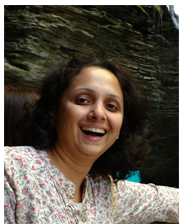 Zestorm Technologies is a Pune based company established in 1999 and specialises in delivering technology solutions focussed on business applications, especially automating workflows and offers solutions which are usable from the browser. The company has an interesting story behind it. Zestorm Technologies is a Pune based company established in 1999 and specialises in delivering technology solutions focussed on business applications, especially automating workflows and offers solutions which are usable from the browser. The company has an interesting story behind it.
From the very beginning, Ashwini had it in her genes to start a company of her own. Zestorm was a company which was incubated by her husband, but Ashwini was part and parcel of all the 'teething' troubles it went through - from looking for office spaces, dealing with erratic Internet connections to dealing with US teams at odd hours. Fortunately, she was able to handle the pressure as the experience came in handy while she started her next venture, The Mango Lounge, which is an offsite offbeat events venue.
She cites that around eight years ago, Zestorm had ventured into some products where they had a tough time selling and scaling up. She realised making the product was easy, but making something that scales and gets into a position where people buy it automatically on their own was difficult. It was during this trying time that her husband ventured out as a Consultant for a short time to earn enough to keep the household running while she managed the company to nurse it back to full operational mode.
As a woman entrepreneur, the main challenge is to manage home, family, kids and a business all at the same time! According to Ashwini, her constant family support helped her to work at odd hours which becomes imperative when dealing with global business clients. Her father is her role model; even at the age of 74, he still works full time and always works on new ideas to implement! She defines success as having peace of mind - where long term success can be achieved by generating passive income without working full time.
It was always Ashwini's dream to be an entrepreneur. She believes that your mind can never be away from your business and you get to be your own boss, working on your own terms.
Ashwini says that the Goldman Sachs 10,000 Women Programme, (with the Indian School of Business (ISB) as Education Partners), played a big role in self-realisation and offered a way to think of potential solutions to various business problems. She continues to ensure that her global customers are satisfied.
Please visit her company's website, http://www.zestorm.com, to know more about the firm's offering.
All the best Ashwini for your endeavours!
back to top ^
|
|

|

|
Wildlife photographer, Rupesh Balsara captures the magnificent male Peacock in his latest trip to the Ranthambore National Park. Though the Park is best known for its tiger population, it also attracts various species of birds, which includes kites, hawks and eagles.
|
|
|
|
Empowered Learning Systems
Pvt. Ltd.
http://www.empoweredindia.com
101, Lords Manor, 49, Sahaney Sujan Park,
Lullanagar, Pune – 411040,
Maharashtra, India


|
 The ELS Lotus logo is trademark of Empowered Learning Systems Pvt. Ltd. The ELS Lotus logo is trademark of Empowered Learning Systems Pvt. Ltd.
©2017 Copyright Empowered Learning Systems Pvt. Ltd. (ELS). For private
circulation to clients and well-wishers of ELS. While ELS endeavors to ensure
accuracy of information, we do not accept any responsibility for any loss or
damage to any person resulting from it.
|
|
|
|
| |