|
|

|
|
Alibaba: The House That Jack Ma Built
|
|
- Duncan Clark
|
|
- Reviewed by Meeta Lee
|
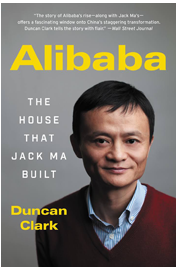 Having read "Alibaba - Changing the face of Global Business" by Porter Erisman and "Alibaba: The House That Jack Ma Built" by Duncan Clark, one cannot miss that Clark, a technological and financial expert, is able to bring out clear and current views not only on Jack Ma's journey from the beginning till present day but also views on the Chinese economy. Clark, who is a former Morgan Stanley investment banker, with over 20 years work experience in China, focuses less on the personal and more on the business environment that both hindered and helped Alibaba's leaders create their empire.
Clark's admiration of Ma is very evident as he describes how a "meeting (and a selfie) with Jack is coveted by Presidents, Prime Ministers and Princes, CEOs, entrepreneurs, investors and movie stars. Jack regularly shares the stage with the world's political and corporate elite. A masterful public speaker, more often than not he outshines them".
The famous "beer" search story is what led to the birth of Chinapages.com in 1995. Though the website did fine, there were financial issues and eventually a state-owned enterprise, Zhejiang Telecom, took over the company. Ma had to move back to Beijing to take up a job in the Ministry of Foreign Trade and Economic Cooperation, where he built trade websites for the government. Red tape did not make him happy so in 1999, Ma left the ministry to start his new Internet venture, Alibaba, which today is one of the world's largest e-commerce companies.
Comparing Alibaba to Amazon, Duncan educates the readers on how Alibaba works on a marketplace model not investing in warehouses. The early funding stories from Morgan Stanley and SoftBank are also an interesting read. Jack Ma's iron triangle strategy (e-commerce, logistics and payment), is an interesting concept to understand the success of Alibaba because during the 1990s, e-commerce, logistics and payment methods were non-existent in China and how there was no concept of customer service. All this made it very challenging for Ma to build an e-commerce industry in China.
One of the other many interesting stories in this book is about how Alibaba proposed an e- commerce deal with China's state-owned China Post which got turned down and resulted in private courier firms coming up across the country. Another such interesting story is about the struggle between Alibaba and the e-commerce titans, eBay and Yahoo, for profitability and marketplace saturation in China.
The last two chapters of the book are a peek in the future. Jack has recognized the importance of mobile utility and how his arch-rival Tencent's WeChat has completely conquered the consumer environment (nearly one billion people) with a one-stop user interface that includes payment. Alibaba tried to launch a competing product but were too late to market. According to Duncan, Jack is already the standard-bearer for China's consumer and entrepreneurial revolution and is currently advancing on new fronts such as finance and media and wading into deeper waters. Having read "Alibaba - Changing the face of Global Business" by Porter Erisman and "Alibaba: The House That Jack Ma Built" by Duncan Clark, one cannot miss that Clark, a technological and financial expert, is able to bring out clear and current views not only on Jack Ma's journey from the beginning till present day but also views on the Chinese economy. Clark, who is a former Morgan Stanley investment banker, with over 20 years work experience in China, focuses less on the personal and more on the business environment that both hindered and helped Alibaba's leaders create their empire.
Clark's admiration of Ma is very evident as he describes how a "meeting (and a selfie) with Jack is coveted by Presidents, Prime Ministers and Princes, CEOs, entrepreneurs, investors and movie stars. Jack regularly shares the stage with the world's political and corporate elite. A masterful public speaker, more often than not he outshines them".
The famous "beer" search story is what led to the birth of Chinapages.com in 1995. Though the website did fine, there were financial issues and eventually a state-owned enterprise, Zhejiang Telecom, took over the company. Ma had to move back to Beijing to take up a job in the Ministry of Foreign Trade and Economic Cooperation, where he built trade websites for the government. Red tape did not make him happy so in 1999, Ma left the ministry to start his new Internet venture, Alibaba, which today is one of the world's largest e-commerce companies.
Comparing Alibaba to Amazon, Duncan educates the readers on how Alibaba works on a marketplace model not investing in warehouses. The early funding stories from Morgan Stanley and SoftBank are also an interesting read. Jack Ma's iron triangle strategy (e-commerce, logistics and payment), is an interesting concept to understand the success of Alibaba because during the 1990s, e-commerce, logistics and payment methods were non-existent in China and how there was no concept of customer service. All this made it very challenging for Ma to build an e-commerce industry in China.
One of the other many interesting stories in this book is about how Alibaba proposed an e- commerce deal with China's state-owned China Post which got turned down and resulted in private courier firms coming up across the country. Another such interesting story is about the struggle between Alibaba and the e-commerce titans, eBay and Yahoo, for profitability and marketplace saturation in China.
The last two chapters of the book are a peek in the future. Jack has recognized the importance of mobile utility and how his arch-rival Tencent's WeChat has completely conquered the consumer environment (nearly one billion people) with a one-stop user interface that includes payment. Alibaba tried to launch a competing product but were too late to market. According to Duncan, Jack is already the standard-bearer for China's consumer and entrepreneurial revolution and is currently advancing on new fronts such as finance and media and wading into deeper waters.
And though we all are aware that China's e-commerce environment overall is facing some existential challenges, one thing is certain: e-commerce has forever changed shopping in China, and with breath-taking speed.
To read the complete issue click here.
|
|
|
Empowered Learning Systems
Pvt. Ltd.
www.empoweredindia.com
101, Lords Manor, 49, Sahaney Sujan Park,
Lullanagar, Pune – 411040,
Maharashtra, India


|
 The ELS Lotus logo is trademark of Empowered Learning Systems Pvt. Ltd. The ELS Lotus logo is trademark of Empowered Learning Systems Pvt. Ltd.
©2017 Copyright Empowered Learning Systems Pvt. Ltd. (ELS). For private
circulation to clients and well-wishers of ELS. While ELS endeavors to ensure
accuracy of information, we do not accept any responsibility for any loss or
damage to any person resulting from it.
|
|
|
|