 I am sure that all of us grew up learning the old adage that practise makes perfect. And when you apply this learning you find that this works!! So why then, do we feel powerless when we are supposed to feel powerful? Why can we not summon up courage and do what we are so good at doing during those crucial hours when we are supposed to give our best? I am sure that all of us grew up learning the old adage that practise makes perfect. And when you apply this learning you find that this works!! So why then, do we feel powerless when we are supposed to feel powerful? Why can we not summon up courage and do what we are so good at doing during those crucial hours when we are supposed to give our best?
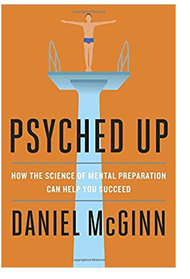
In Psyched Up, journalist Daniel McGinn reveals why the last few minutes before any major challenge can be terrifying. McGinn has interviewed athletes, soldiers, entertainers, and others, who despite years of practice and enviable track records, ultimately get judged on their ability to deliver a solid performance when it is their turn to shine. He talks about the importance of mental preparation over and above the physical practise and has backed it up by giving examples of top professionals who have been putting this technique to work - superstars like General Stanley McChyrstal, National Association for Stock Car Auto Racing (NASCAR) champion driver, Jimmie Johnson, Boston College football coach Steve Addazio, legendary tennis coach Nick Bollettieri, T-Mobile CEO, John Legere, and many more. Interestingly, this book was written by him on Malcolm Gladwell's old keyboard. The author has a strong belief in the research studies on superstition done by a team led by Sally Linkenauger, a research scientist. The studies revealed that a professional's skills, which had rubbed off on a piece of equipment, would benefit anybody else who used the same equipment (called positive contagion).
Contradictory to the belief that one must try to calm their nerves before an important moment or performance, McGinn is of the opinion that instead of aiming for calm, a better strategy is to force yourself to make the more subtle, achievable mental shifts from nervousness to excitement - a process called re-appraisal. Another interesting technique mentioned in this book is a seven-step technique called 'Centering' which help performers manage energy and arousal in the moments before a performance. Clearly, it is not an easy process to read and learn and therefore requires someone to teach it.
The last chapter of the book, "The Psyche up Pill" has very interesting dimensions on whether white collar workers should medicate their way towards high performance. McGinn who himself uses medication during extremely busy periods and rare speaking appearances, is against the idea of getting addicted to them. The book ends with an amusing anecdote of him playing golf extremely well after using the 'magic' pills and how, though the PGA has outlawed the use of beta-blockers, the rule does not apply to him since he is not a PGA player. It is a good book with lots of interesting examples and keeps you glued till the end.
Daniel McGinn is a senior editor at Harvard Business Review and a national correspondent at Newsweek. His writing has appeared in magazines such as Wired, Inc., and the Boston Globe Magazine.
To read the complete issue click here.
|





 The ELS Lotus logo is trademark of Empowered Learning Systems Pvt. Ltd.