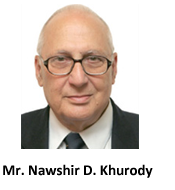
 With an executive career mostly with the Tata Group, Mr. Nawshir D. Khurody served as the Managing Director of Voltas Limited where he worked in the areas of international operations and exports at Voltas. Mr. Khurody joined the Tata Administrative Service, with postings in the steel, tea and engineering interests of the Tata Group. For seven years, he was associated with the Corporate Management of Mannai Corporation, Qatar, returning to India to take up the stewardship of the pharmaceutical interests of the Tata Group. He holds a Master of Arts Degree in Economics (Hons.) from Trinity College, Cambridge University in 1958. Post-retirement, he serves on a few Boards and undertakes assignments to help corporates move to the next level towards global sustainability.
ET: The recent uproar about Non-Performing Assets in Banks and the misuse of public funds even by public listed private sector companies has brought to attention the non-effectiveness of Boards. What makes for a high performing Board?
NK: A "high performing Board" has to be totally free of outside political forces. In this sense, the entire Board is independent, not just the independent Directors. Sadly, Boards feel that they owe their loyalty to the forces which appointed them. So, a "high performing Board", has to be composed of people who are always somewhat at a distance from the power-blocks in institutions/banks/companies. Also, the composition of the 'Agenda' drives for quality. Boards need to be more strategic, less operational.
How often do Boards evaluate:
- The human capital within?
- The external factors that can disrupt the business model in use?
- The relevance and health of the technology used?
- Their own performance via key parameters?
- The SWOT relevant to the Company?
- Options of growth, via M&A?
- Risk mitigation via designed processes? and so forth.
ET: Realistically, large Indian firms were founded by strong individuals, before they got listed. Hence, even today they basically remain feudal as the strong shadow of the promoter and his family is over-whelming. Comment.
NK: Feudalism is rampant, though not admitted. Just because the owner uses professional Managers, does not make the organisation neutral to heritage. The MNC, like ITC, is feudal.
I wish to emphasise that deferring to the Chair continues even in companies headed by Managers. Take L&T and ITC as two blatant examples. This weakness is in the DNA of many Boards who feel it would be in bad taste to challenge the views of the Chair, even though this is not occupied by the Promoter but by a processional, risen from the ranks. Boards confuse open debate with disrespect, and independent Directors fear removal, should they be seen as truly independent. Hence, debates at Boards are rare, and when they do happen, tend to be watery.
ET: In your opinion what role can the Board play in creating good organisational culture to reach operational excellence? Please elaborate.
NK: Operational excellence can only be achieved on a sustainable basis when the Purpose of the organisation is accurately aligned to the Processes that drive the Purpose. In turn, the people selected to run the processes, must be aligned accurately, to the former Purpose - Process. This is not easy and calls for continual 'tuning'. Very few Boards even discuss, in general terms, the internal alignments, as mentioned above.
ET: Corporate governance is much bandied about in business circles, and Company Law has also been amended to improve business practices. Given your wide experience on company matters, in your opinion, has the ground reality changed? Has any Board been found culpable for mis-governance in a firm?
NK: To the best of my knowledge, no Board has been found culpable. Because individuals are blamed and the Board is never really seen as the Chief Individual Officer of the organisation. Without any laws, corporate governance can be practised if this, along with financials, etc., is seen as a Must-Goal. Good companies, go well beyond legal compliance of governance. I have yet to succeed in persuading Boards to devote one meeting, every 6 months, to self-reflection against a pre-set framework of best/desirable practices.
ET: 'Changing times, changing relationships.' As a member of various Boards, what are the changes that have taken place in recent times within Boards which adapt to the changing times? What more can be done to professionalize a Board's performance?
NK: Yes, a few changes have occurred, as companies do not now have the comfort zone of yesteryears. The changes are in MIS, risk analysis, and in competitiveness, principally. But a lot more needs to be done in altering the SPINE of the Agenda. Financials for the quarter can be seen on laptops. What cannot, are the threats to the assumed source(s) of competitive advantage. Hence Boards need to periodically and systematically have an Agenda which asks:
- What were we to start today? What would be our shape, strategy and key strengths?
- How does our Talent Pool measure up?
- How fast and accurate are 'decisions' taken?
- Does the Leadership Team have foresight vs just forecast?
- Independent Directors to meet and make joint presentations on critical matters.
- How is our cultural image in the customer domain and in the stakeholder domain?Do we exude Trust?
- Are we a Talent magnet? How do we know that our Training & Development model, spirals to the best?
- What are the 5 to 10 things on which the Board will not compromise, and why?
- How do we spot mediocrity - the weeds of which can smother creative, innovation?
- Balanced composition of Boards, pre-set core agendas, pre-set frequency of meetings to last not less than 4 hours.
To read complete issue click here
|







 The ELS Lotus logo is trademark of Empowered Learning Systems Pvt. Ltd.